

Teachers’ professional development journeys
This report covers a study which followed a group of 40 teachers over the course of one academic year to gain an in-depth understanding of professional development, and of how the quality of teacher professional development and the perceived impact of professional development varies across different teachers and changes across the period of one year.
Acknowledgements
The authors would like to thank our panel of teachers who kindly gave up their time to provide their insights and experiences and who stuck with the project across the whole 12 months; this project would not have been possible without you. We are also indebted to Alan Passingham, Rachel Williamson and Karolina Deligiannidi at Ofsted for supporting and guiding the research; and to Roots Research for recruiting our wonderful panel of teachers. This project has also benefited from the expertise of Sara Butcher, Zoe Gallagher, Ehecatl Hunt Duarte, Ellie Cooper and Rebecca Duffy at IES for administering the consultation surveys, supporting the research workshop and formatting the report. Finally, thank you to Ofsted for funding this research and continuing our learning and understanding of teacher professional development.
Contents
2.1 Defining professional development
2.2 What professional development are teachers getting?
2.3 What makes for good quality professional development?
2.4 Drivers for engaging in professional development
2.5 Barriers and facilitators to professional development
3.1 What professional development are teachers getting?
3.2 Expectations and experiences
3.3 Further reflections on effective professional development
3.4 Impacts of professional development
4.1 What professional development are teachers getting?
4.2 Professional development activities at the school
4.3 The importance of professional development
4.4 Changes in professional development over careers
5.1 Reflections on professional development across the year
5.2 Impacts of professional development
5.4 Perceptions of good practice in schools
Appendix A: Cohort characteristics
Appendix B: Consultation survey (Wave 2)
Summary
The study followed a group of 40 teachers[1] over the course of one academic year to gain an in-depth understanding of professional development, and of how the quality of teacher professional development and the perceived impact of professional development varies across different teachers and changes across the period of one year.
The research found that teachers view professional development broadly, and it can be more than about gaining qualifications or climbing the career ladder. Teachers engage in a wide range of professional development: from formal qualifications such as master’s degrees or specific teaching qualifications such as National Professional Qualifications (NPQs); externally provided courses, coaching and mentoring; training delivered by the senior leadership team (SLT); other teacher-led training; observing others and visiting other schools; shadowing; peer-to-peer learning or networking; through to doing their own reading and research. They felt that professional development mostly takes place within the school, which differs from experiences of several years ago. They felt this could reflect reduced resources and different governance and school management structures. The move to in-house development was considered a positive move by some as it leverages and recognises staff expertise.
There are different drivers to participate in professional development, some are state-driven, some are school-driven, some are self-driven (focusing on a teacher’s own needs and interests). Professional development can be seen as integral to the teaching role, about being able to change and adapt, about career progression, or enabling teachers to follow an interest or wider life goals. With state-driven and school-driven professional development, those in leadership positions may need to explain to staff what development they are rolling out and why.
Teachers’ experiences of professional development vary. Teachers often engage in several different types of professional development at the same time. However, some had no recent experience beyond INSET days and feel overlooked, particularly those working part-time, in low deprivation areas or more experienced teachers. Tailored and individually focused professional development appears to be preferred but this is perceived as rationed, and not available to all. There were relatively few experiences described of externally provided professional development (e.g. provided by local authorities (Las), specialist providers or wider networks), but this was often what teachers gravitated towards when thinking about quality professional development.
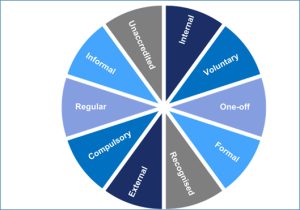
Five dimensions to professional development or ways to describe different professional development experiences were determined: internal to external, voluntary to compulsory, one-off to regular, formal to informal, and unaccredited to recognised. This illustrates how the nature of professional development involves sliding scales of formality (from formal qualifications to informal conversations), of frequency of delivery, and opportunities to network and collaborate. The wider work of Ofsted suggests other dimensions that could be used to characterise different schools’ approaches to teacher development. These include the degree of individual control or choice, recognition of expertise, sharing learning, level of resource and leadership encouragement and school culture. This brings in aspects often perceived as indicators (or concepts) of quality, drivers or motivations to professional development, and facilitators to development.
Teacher insights indicate that good quality and effective professional development – development that is helpful, useful and impactful – needs to be: relevant and relatable (e.g. chosen, tailored and based on robust evidence and quality research), engaging and practical (e.g. with interactive elements and practical takeaways), convenient (e.g. respectful of teachers’ time which is precious, and their wider commitments and work/life balance), and cost-effective (in order for it be signed off). It should also involve self-assessment and reflection; have credible, enthusiastic and expert trainers; and ideally involve consultation and choice (to ensure it is meaningful, impactful and valued). When talking about quality and effectiveness, teachers tend to focus on formal rather than informal development activities; yet informal development was often considered powerful and impactful. This suggests that individuals don’t use the same criteria or judgement in terms of what quality means for informal development. Teachers experienced a range of teaching techniques in their professional development and whilst some find a technique useful and a positive experience, others do not find it so (e.g. observations). One clear and strong preference is for school visits to see and experience good practice first hand. However, teachers recognise that this requires resourcing to provide for staff cover.
The main reported barriers to professional development are lack of time and lack of funding. Others include lack of support and encouragement, lack of a suitable learning environment, not being aware of opportunities or not meeting eligibility requirements, lack of interest and poor accessibility. Access to, engagement with, and experiences of, personal and professional development are often affected by issues beyond the teacher’s control such as workload, working hours, evolving technology and theories, changing wider context and cost pressures. Facilitators were often the opposite to the barriers, and included protected time and budget, a range of ways to access development (with online providing convenience and flexibility but face to face considered more engaging), making professional development part of the school culture, and timing professional development for the least disruptive periods of the year. The importance of senior leadership and school culture in access to (and value of) professional development should not be understated, and only half of the teacher cohort felt their school management understood their professional development needs.
Experience of professional development changed over time and so potentially did the relative importance of professional development. It was felt to change over a teacher’s career and to be influenced by time in post, seniority, career and life stage, and caring responsibilities. The volume of professional development was perceived to reduce over a career – with it being most important when starting out, making transitions and moving up the career ladder. The volume of professional development was also felt to have reduced over time and the nature changed over time, particularly in recent years. This was due to reduced funding, with fewer external courses and greater reliance on internal or online courses, but also due to the influence of the COVID-19 pandemic, which shifted training to be dependent on individuals’ own investment in their careers. Expectations for professional development didn’t always match reality. Some teachers were underwhelmed and frustrated with the professional development opportunities available to them and felt this limited their progression and meant they couldn’t improve on their practice. However, others felt overwhelmed with professional development, particularly when this was whole school (and imposed), rather than development that was tailored and chosen.
Teachers felt there was little professional development activity around mental health and wellbeing and children with Special Educational Needs and Disabilities (SEND) training. Where mental health and wellbeing activities were experienced, this was generally part of Early Career Framework (ECF)-based induction, focused on pupils or to deal with a specific situation. Only around one-third of the teacher cohort had received SEND training. This was generally delivered via their Special Educational Needs Coordinator (SENCO) or local council or borough. Professional development in these areas would be welcomed and was a key desired area for future professional development, particularly as staff are seeing more children with behavioural needs and additional needs. Looking to the future there was also a desire for subject-specific training and development, development around behaviour management, and to meet teachers’ own professional goals. Teachers also talked about wanting to visit and observe other schools. However, planned professional development tended to focus on statutory training (e.g. safeguarding), although some teachers had subject courses, mentor training, leadership training or NPQs lined up.
Professional development leads to range of impacts, including: self-improvement in terms of teaching practice and pedagogical knowledge; responsiveness to pupil needs and improved student engagement, participation, and confidence; and supporting wider curriculum development. Teachers recognise that professional development creates additional workload which can be a deterrent; however, there is a general desire for more than currently offered. The potential for positive impact from professional development was felt to depend on the quality, volume and timing of professional development.
[1] We use the term teachers to refer to the members of the cohort; these include classroom teachers, early career teachers, middle and senior leaders.
1 Introduction
The Institute for Employment Studies was commissioned by the Office for Standards in Education, Children’s Services and Skills (Ofsted) to carry out a teacher cohort study to track teachers’ professional development journeys over one year.
The aim of the research was to follow a group of teachers with different backgrounds, roles and experiences in order to gain an in-depth understanding of how the quality of teacher professional development and the perceived impact of professional development varies across different teachers and changes across the period of one year. It was not an evaluation of the professional development of teachers but research to explore the opportunities available to teachers and recent experiences of development. The key research questions were:
- What professional development are teachers getting?
- What is the format of the development they receive?
- What is quality of their professional development?
- What is the perceived impact of their professional development?
- What are the barriers to and facilitators of professional development?
The research forms part of the independent review of teachers’ professional development in schools led by Ofsted and commissioned by the Department for Education (DfE).[2] The review focuses on teachers’ and leaders’ experiences of the training and development engaged in since April 2021 and covers the reforms introduced in recent years to support teacher recruitment and retention. These include changes to statutory induction for early career teachers (ECTs), and reforms to the suite of national professional qualifications (NPQs) for teachers, middle leaders and senior leaders.
1.1 Approach
The research took a qualitative approach to allow for reflection, gain true insights and support tracking over time. It involved a sampling and recruitment stage followed by four waves of data collection.
A sample specification was designed in collaboration with Ofsted to ensure that a diverse group of teachers were recruited.[3] The sampling criteria included school characteristics: school phase, school governance, Ofsted judgement, and measures of local deprivation. It also included teacher characteristics: experience of formal professional development, years of teaching experience, level of seniority, age, gender and ethnicity. Teachers were recruited using the support of a specialist panel company and screened to ensure that minimum set quotas were achieved.
In total 40 teachers were recruited to the research to form the study cohort and they represented a wide range of experiences and settings. See Appendix A for a breakdown of the cohort.
Data collection was undertaken over four waves, with some attrition over time. Each wave allowed for experiences to be tracked across school the year, for new areas to be explored, and aspects to be revisited to develop a deeper understanding of core themes:
- Wave 1 involved semi-structured interviews via phone or video conferencing with all 40 members of the cohort. Each discussion lasted between 45 minutes and one hour and took place between October and November 2022.
- Wave 2 involved an email consultation with a mix of closed and open questions.[4] It included seven open questions gathering substantial feedback. See Appendix B for a copy of the consultation questions. All the cohort were invited to undertake the consultation survey and in total 39 members of the cohort submitted answers. The consultation survey took place between February and March 2023.
- Wave 3 involved a further round of semi-structured interviews via phone or video conferencing with each discussion lasting between 45 minutes and one hour. All the cohort were invited and in total 33 members of the cohort participated in interviews. The interviews took place between June and July 2023.
- Wave 4 involved an online workshop via videoconferencing lasting 90 minutes. The workshop included a presentation on the findings to date and breakout discussions to reflect on the findings and discuss and share experiences. All the cohort were invited and 13 participated in the workshop that took place on 24 November 2024. [5]
The rest of the report presents the findings from each wave with our teacher cohort. We use the term teachers throughout the report to refer collectively to the members of the cohort; these include classroom teachers, early career teachers, middle and senior leaders.
[2] Phase 1 findings are reported here: https://www.gov.uk/government/publications/teachers-professional-development-in-schools-phase-1-findings/independent-review-of-teachers-professional-development-in-schools-phase-1-findings
[3] This was a purposive sample. The sample specification set out non-interlocking minimum quotas to ensure a spread of teacher characteristics, experiences and school settings. The achieved sample was designed to be diverse but not to be representative of the teacher population. See the Appendix A for the characteristics of the achieved sample.
[4] Closed questions restrict answers to a limited number of options. Open questions allow for free text responses and therefore for deeper insights.
[5] The cohort were polled to identify the most convenient date and time for the workshop, but it was expected that only a subset of the cohort would be able to attend in person due to workload and commitments. The attendees were mixed in terms of gender, seniority, length of experience, school setting and school phase.
2 Wave 1 findings
Semi-structured interviews in the 2022 autumn term with 40 teachers from across England, with varying roles and length of experience, explored what professional development meant to them, what professional development they had undertaken in recent months, what makes for good quality professional development, motivations to take up or seek out professional development, and barriers and facilitators to professional development.
2.1 Defining professional development
The cohort were asked what professional development meant to them personally. Their comments illustrate how professional development tends to be defined broadly, encompassing a range of activities, but that it is about developing their skills, abilities, knowledge and confidence in teaching.
‘When I first started, I thought professional development was about going on courses. Now, I think it’s about developing your own practice by finding professional development that is sustainable and impactful.’
‘Professional development means learning new skills, adding something to my career or for the children to benefit them or for me to take learning further.’
‘Not just climbing the ladder, important to stay aware of where education is moving to and do the reading around.’
‘Making sure you are up to date with teaching and learning techniques. It is important to never stand still as a teacher and have the latest training and improve what you are doing for students.’
‘Professional development allows you to share best practice and ideas, you need that motivation in teaching, it’s important, especially when new to the profession. Lots to learn from those in the profession for 20 years…. especially at the start of your career. Stops you getting into bad habits, helps you to streamline your working. Find quicker and more efficient ways of working.’
‘Learning from watching other teachers. Getting a variety of experiences is helping me develop. I am still learning, not perfect, I have to learn from my mistakes.’
‘Improving subject knowledge, being up to date with recent events, being up to date with new trends, what are the new things in terms of research (e.g. kids wellbeing), knowing what’s happening right now, subject knowledge is key, having someone go through things and refresh (have so many other things going on), trying new things, different ways of keeping kids engaged.’
‘Subject–specific professional development is about developing the music subject, making the lessons engaging to as many students as possible. Gaining experience with different instruments and new knowledge, keeping up with changes in knowledge.’
‘On the pastoral side, it’s learning how to be as inclusive as possible, SEN, pupil premium etc., having the knowledge and strategies to deal with this.’
‘Working on your areas of low confidence and weaknesses and strengthening them to make you a better teacher.’
2.2 What professional development are teachers getting?
The cohort described the professional development they were engaged in the 2022 autumn term (the timing of the wave 1 interview), what they had recently received (during the 2022 summer term) and had planned for the rest of the academic year (2022 to 2023). Reflecting how broadly they defined professional development, teachers in the cohort reported a wide range of professional development. This ranged from formal qualifications and lengthy programmes through school-based training to more ad hoc and informal experiences such as peer support and self-directed learning. The types of development described included:
- wider qualifications (National Vocational Qualifications (NVQs), master’s degrees);
- NPQs, including NPQSL;
- Early Career Framework (ECF)-based induction programme;
- attending external courses (online or in-person);
- external provider delivering to the school/hub;
- top-down training by the Senior Leadership Team (SLT);
- coaching/mentoring (in school by SLT or senior teacher, or externally provided);
- teacher-led training (e.g. presentation after attending course, cascading learning);
- seeking new experiences/roles (e.g. marking for an exam board);
- observations (of or from SLT; teacher visiting other schools or classrooms);
- shadowing;
- peer-to-peer learning;
- networking; and
- own reading/research.
The teachers in the cohort were generally engaging in several different types of professional development. However, some teachers had no recent experience of professional development beyond in-service training (INSET)[6] days.
2.2.1 Dimensions of professional development
The teachers described in detail the professional development they were undertaking or had received recently. They explained who instigated the opportunity, the intended impact, how it would fit with their own development hopes and needs and wider school needs or strategies, what motivated them to get involved, the focus and coverage of the development opportunity, how it was delivered and by whom, and the impact it had. From these detailed descriptions, five key dimensions were identified, and these can help to categorise professional development.
- Internal to external: ranging from training delivered within the school/trust by fellow staff, often within the department or by the senior leadership team, to activities delivered externally, often by recognised experts.
- Voluntary to compulsory: ranging from activities that staff opt in to, are invited to or request to undertake, to those where staff are required to participate (these can be school or state mandated). The latter is often linked with whole school/trust initiatives.
- One-off to regular: ranging from a one-off or ad hoc opportunity (which may or may not have been planned) to two or more sessions which could be part of a programme potentially involving additional work and reflection in between the sessions.
- Formal to informal: ranging from development that is planned and structured with set objectives to something less deliberate and that can occur naturally within teams and networks.
- Unaccredited to recognised: ranging from learning and training that has no certification or wider recognition to development leading to accreditation and recognition which can be used as evidence for progression.
[6] Teachers in schools following the School Teachers’ Pay and Conditions Document (STPCD) have five days a year (of six hours of directed time per day) where they are required to be available for work but pupils are not in school. These days are used for purposes other than teaching and so can be used for a variety of activities but particularly professional development. Schools can decide how to spread the in-service training (INSET) days across the academic year and headteachers decide on the content to be included. See, for example: https://www.edapt.org.uk/support/knowledge-base/inset-days-what-are-my-requirements-to-attend/
Figure 1: Dimensions of professional development.
Source: IES teachers’ professional development journeys research, 2023-2024
The following examples of the professional development described in detail illustrate how the dimensions can be used to categorise or define what teachers receive.
Example 1: professional coaching programme
Dimensions: external – voluntary – regular – formal – unaccredited |
Example 2: NPQ
Dimensions: external – voluntary – regular – formal – recognised |
Example 3: in-house sessions
Dimensions: internal – compulsory – regular – informal – unaccredited |
Example 4: twilight session
Dimensions: internal – compulsory – one-off – informal – unaccredited |
2.3 What makes for good quality professional development?
The teachers described from their experience what makes professional development good quality, and in particular what makes it useful, helpful or ensures it has an impact. Four key themes emerged:
Relevant and relatable
Professional development needs to have immediate application and be useful, have an impact on everyday practice, tailored, develop subject matter expertise, help with specific issues children have (e.g. autism, diabetes, English as an additional language (EAL)), lead to promotion or better job opportunities, be necessary for new job or role, act as an incentive to stay working at the school.
Engaging and practical
Professional development needs to be engaging and practical – in terms of the subject matter, mode of delivery and quality of trainer or expert (teacher or former teacher). It should provide opportunities and time for reflection, allow for feedback and follow-up, allow for sharing practice with other teachers and networking, be grounded in (recent) research that has a demonstrated impact, be based around real-life scenarios and specific examples in practice, and involve accreditation.
Convenient
Professional development needs to be convenient – for some online provision provides convenience. It should be local or close by as the distance from school can be an issue (this is more challenging for rural schools) particularly for those with transport issues. It should be timed for convenience preferably during school hours (perhaps using INSET days or Planning, Preparation and Assessment[7] (PPA) time) and allow for time away from the classroom or time away from the school. It should require limited additional work or planning.
Cost-effective
Professional development needs to be cost-effective – taking account of the cost of cover for a teacher attending training or leading training and coaching sessions, the cost of the training course or consultant, and economies of scales with multi-academy trusts (MATs). It should also take account of the cost of transport and subsistence.
‘Their comments illustrate how good quality means a mixture of things, encompassing each of the four themes.’
‘If the person that’s leading it is also or has also been in your position, also a teacher, not just a consultant who has never spent time in classroom. Because the ability to implement it might be difficult. Practicalities can be unrealistic or unsuitable for schools, children in the county vs city schools are different. It’s more effective when delivered by someone who has been in the classroom and can talk from experience.’
‘Not imposed from outside, must be relevant to your performance management, not blanket applied to everyone. Trainers need to have relevant up-to-date knowledge of classroom practice, be experienced teachers.’
‘Short snappy, memorable, theory based but with practicalities of “this is what you could do”. There are way too many [training sessions] when it’s “they have read a book and this is what they do”. Don’t have the time to think about how you could implement it, you need real ideas of what you could try.’
‘Had enough time for discussion, was an all-day session, the amount of ideas shared meant that you felt like a different teacher at the end. A lot of time for reflection, thinking “What do I do?”, “How can I improve?”.’
‘When it has a clear purpose to it and has actual, practical strategies you can use. Need to literally say, “this is how you can use it in the classroom / in practice”. …. CPD focusing on evidence, academic research is useful because you can tell that it’s not just something random. Hearing someone just talk to you for an hour can be dull. It is useful to have group work. Like more of a workshop than a lecture.’
‘Speaking to experienced colleagues, seeing them, viewing them. I’ve learnt more watching colleagues and viewing them and thinking “oh that works well” or “ooo not sure that would work for me”. I think some of the best professional development is looking at how to do things and observing them.’
2.4 Drivers for engaging in professional development
When describing what professional development meant to them and their recent development experiences, comments indicated a range of motivations or drivers to engage in professional development. There were three spheres of driver: national level drivers, trust or school level drivers, and individual drivers.
- National or regional level drivers: these were often statutory driven by DfE or Ofsted requirements. For example, focusing on safeguarding, health and safety, SEND, national curriculum changes, and early career teacher (ECT) induction. At this level, every teacher is involved.
- School- or department-driven: here the focus tends to be on local priorities and context for improvement. For example, focusing on pupil behaviour, curriculum, and assessment methods. At this level many (but not all) teachers are involved.
- Individual or self-driven: here the focus is on individual needs and interests. For example, to develop subject expertise, respond to class or pupil(s) needs, as part of performance management, to aid progression, to keep up to date (take account of emerging research evidence), acquire new teaching techniques, follow a personal interest, or to support or enable a change of role. At this level, development is targeted, and so few teachers are involved.
2.4.1 Professional development for progression
Exploring individual drivers further, progression is a key individual level motivator to seek out and engage in professional development. Teachers in the cohort described how professional development could help them to progress within their current school or MAT or to help them to move on to a different school or setting. Professional development could be useful in the following ways:
- to prepare for or become eligible for the next role;
- to signal internally that you are ready and keen for progression;
- out of concerns about being overlooked;
- to add to your CV, and signal externally to potential employers of your skills and capabilities; and
- to learn more about the new role after progression; to gain confidence.
A number of issues arose when discussing using professional development for individual progression. Here teachers were concerned that progression-based development might be at odds with or at least less acceptable (deemed less worthy) than professional development linked to immediate challenges facing pupils. It was noted that progression isn’t necessarily a goal that everyone has, some teachers may not feel ready to progress or that it is not a priority for them at that point in their career. There was a perception that progression inferred moving towards leadership and that would lead individuals away from classroom teaching, something they enjoyed, felt was important and acted as a major motivator to entering the profession. It was also noted how progression itself can be the catalyst, rather than the result of, professional development. For example, a person may seek professional development to help them cope with a change in role or responsibilities. Here teachers talked about moving to teach different year groups or key stages, taking on additional responsibilities, or increasing their seniority within their year group, department, subject or key stage.
[7] Teachers who participate in the teaching of pupils are entitled to reasonable periods of Planning, Preparation and Assessment (PPA) time as part of their working hours. Government guidance sets out that PPA time must be provided in units of not less than half an hour during the school’s timetabled week and must amount to not less than 10% of the teacher’s timetabled teaching time, and a teacher must not be required to carry out any other duties during this time. See https://assets.publishing.service.gov.uk/media/64257c6060a35e000c0cb1de/Modification_of_STPCD_2022.pdf
2.5 Barriers and facilitators to professional development
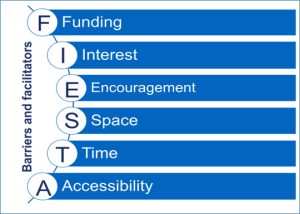
Teachers in the cohort spoke about the barriers that had prevented them from taking up professional development opportunities or being able to fully engage with or complete professional development activities. They also described barriers that faced their colleagues and reflected on how barriers had changed over time. At the same time, teachers advised on what had acted as facilitators to make professional development accessible and help them stay engaged, and what helped them most. It was clear that barriers and facilitators were largely mirrors of each other and could be grouped into six areas.
Figure 2: FIESTA – barriers and facilitators to professional
Source: IES teachers’ professional development journeys research, 2023-2024
Funding
This group included finance and resources to cover training costs, staff cover, and expenses. This is influenced (positively thus acting as a facilitator, or negatively thus acting as a barrier) by national policy, school/trust priorities and potential for economies of scale, and also personal circumstances.
Teachers described how their school can’t afford to pay for external training, that the cost of cover was deemed too high or unavailable, or that the cost of transport and subsistence was too high. Additionally, some felt that the COVID-19 pandemic had created new challenges for the sector and thus new priorities for funding. This meant that schools needed to think creatively about how to provide development opportunities, for example through shared learning, pooled resources, coaching, and train the trainer to cascade learning. It was felt that some schools are able to secure more funding than others.
Interest
This group included extent of self-motivation, personal drive, ambition and also individual’s goals and their understanding of their own development needs. This is influenced by life/career-stage, and wider factors e.g. well-being.
Teachers noted how some could have an apathy to professional development. An individual’s life or work stage meant professional development was less of a priority (perhaps those getting ready to retire, or those already in the SLT) or they saw no value-added in the development offered and viewed it as rehashing and repackaging what they already knew or had learned. Often those in more senior positions felt that professional development was not necessary for themselves, and with the financial pressures faced by schools and the wider sector they would prefer to target other staff for opportunities and thus ‘spend the money on others’. Others noted how professional development was not a priority for them, and instead it was the ‘day-to-day grind’ that was their current priority.
Encouragement
This group included support and encouragement from the SLT, colleagues and family. This is influenced by the school culture, development champions and gatekeepers and their School Development Plan (SDP).
Teachers emphasised the importance of the school culture and a lack of encouragement from their SLT or school would deter them. They also noted the presence of ‘gatekeepers’ who restricted the promotion of or access to opportunities, that it was normal for meetings to be arranged during PPA time and that groups targeted for development tended to be narrow (e.g. ECTs, STEM subjects). All these indicated ways in which the school’s perceived attitude to professional development could be experienced.
Space
This group included having a suitable learning environment, both mentally and physically (for example avoiding busy, noisy environments). This is influenced by providers, schools, home set-up and personal preferences.
Time
This group included having dedicated or protected time set aside for development, preferably within core working hours. This is heavily influenced by workload plus work pattern and wider commitments.
Teachers talked about their work-life balance and the influence their wider commitments had on their abilities to take up professional development opportunities. Some noted how they had difficulties finding time to attend training or finding time to do the extra work in preparation for the training or after the course. Their wider commitments meant they had difficulties finding childcare for hours outside of their normal work schedule, and this was particularly difficult for those who worked part-time. They also discussed how pressures at home (e.g. post-maternity leave, childcare demands) coupled with a heavy workload could affect their willingness to engage in professional development.
Lack of time was a common area of feedback. For some their professional development took up too much time: early career teachers on their ECF-based induction noted how their programme was very prescribed and those with experience of NPQs described how these programmes required a lot of hours of self-directed study during personal time. Others noted how requirements of professional development could extend beyond their PPA time or that their PPA time was taken up with other things, which meant development had to be accommodated in their own time, or that time set aside for professional development was taken up with providing cover for other classes. The length of sessions could also be an issue, with some considered too short to gain anything useful and others too long to be able to participate and fully engage.
Accessibility
This group included being aware of and accessing opportunities. This is affected by eligibility requirements, promotion of opportunities, mode of delivery, location and technology required.
Teachers noted how the timing of professional development could affect accessibility; timing in relation to the school day and timing in relation to the school year (e.g. around key assessment/exam periods). They also discussed how the mode of delivery could affect accessibility and how online delivery could be off-putting with some finding it hard to fully engage (particularly when doing so in busy and noisy environments). Teachers described how they often had no awareness and understanding of opportunities on offer due to limited promotion (or that this was only offered to certain groups of staff) or due to the methods and channels used for promotion. Some also noted confusion around the eligibility criteria for certain types of development (e.g. for NPQs). It was also felt that discrimination could affect access to professional development.
The following quotes illustrate the barriers and subsequent frustrations felt but also the facilitators experienced.
‘I would say you have more opportunities for professional development when an early career teacher. Being Head of Department for a while there are less opportunities, you may need to go higher up into leadership to get those opportunities.’
‘I am really lucky in my school and my role; professional development is that much easier. Schools have financial pressures at the moment. The day-to-day grind is the priority rather than enhancing teaching. I feel in a privileged position.’
‘I am conscious that I need time out of class to get my head round the subject but there is no budget for a supply teacher.’
‘I think there is less readily available professional development now. I think it’s a funding thing or pandemic related. When I was early career, I could go on courses at a drop of a hat.’
‘I only recently learned to drive, so half of my career, half of things I wanted to do, I couldn’t get there.’
‘Time is very precious. Time is the biggest barrier. There is a perception that teachers have lots of time, it is just not true, you don’t realise until you’re in the profession how time poor the role is.’
‘Often training sessions are at 5pm. So, I ask myself, ‘do I want to attend sessions then, unpaid?!’ It’s hard to motivate myself, that’s my free time!’
‘Very overworked – teachers want professional development to do their best for students. It is a vocation not just a job, but you don’t have time to improve or develop.’
2.6 Variations in experiences
The cohort reflected how their experiences of professional development changed over time and the current experiences of teachers were compared to see what affected professional development. Experience of professional development appeared to be affected by time in-post, seniority and career-stage, and life-stage (particularly maternity). There was a perception that professional development is more readily available in early career (e.g. that ECTs are ‘lucky’) when individuals tend to have few wider commitments. Those in senior positions tended to talk about the development in their school and prioritised other commitments over their own professional development, they focused on the needs of other staff and thought less about their own development. Those in their mid-career may want professional development but feel they can get squeezed out. As teachers take on family commitments and caring responsibilities this can reduce their capacity for professional development outside of school hours and affect their ambitions. There were particular concerns that maternity leave or having children would negatively impact on opportunities for professional development and progression.
Analysis across the cohort indicated that experience of professional development was affected by a range of factors, many of which were largely beyond an individual teacher’s control. These factors included costs and availability of funding, teacher workload, working patterns, wider change in the sector and the influence of the COVID-19 pandemic. Teachers felt that funding for professional development had been falling across the sector, and that schools had to prioritise low-cost options such as self-study and require teachers to engage in their own time as teacher workload is high and increasing. It was noted how the high workload could also impact on ambitions to progress and to engage in professional development. Part-time staff felt they were missing out, particularly when opportunities arose on their non-working days. It was also noted how evolving technology and ideas meant that learning quickly becomes outdated or obsolete. The COVID-19 pandemic and aftermath was felt to have a wide ranging impact for professional development, affecting access to training and training delivery modes, increasing teacher workloads, leading to staff shortages, and creating new pedagogical issues (e.g. impacting on learning behaviours, increased SEN and mental health issues) and impacts on teacher health and well-being.
3 Wave 2 findings
An email consultation[8] in the 2023 spring term with 39 teachers from the research cohort updated experiences of professional development and explored the timing of development activities. It also investigated expectations for the volume and content of professional development and whether expectations and professional development needs were understood and met, what makes for effective personal development, and the perceived impact(s) of professional development.
3.1 What professional development are teachers getting?
Teachers in the cohort described the professional development they were undertaking in the 2023 spring term. Their descriptions tended to focus on the content of the training and the delivery mechanism or format. These indicated the range of development undertaken and also that this was mainly in-school delivery.
The content of their professional development focused on:
- Health and safety.
- Subject-focused development.
- Managing pupil behaviour.
- Classroom practice projects (e.g. Philosophy for Children).
[8] See Appendix B
| Examples of professional development
Maths Mastery; fire marshal training; first-aid training; annual safeguarding; self-harm and suicide prevention; class-room routines, transitions and habits of attention in the classroom; behaviour, culture and attitudes; marking, assessment and moderation; and mentoring. |
The format of the professional development included:
- Online sessions (webinars to longer courses).
- Weekly CPD meetings.
- Cross-curricular observations.
- Peer assessment.
- Twilight sessions.
- INSET days.
- Formal CPD (NPQs/ECT induction).
3.1.1 When do staff engage in professional development?
Most commonly (reported by almost two-thirds of the cohort), the teachers undertook their professional development during directed time. This tended to be before or after the school day, for example staff meetings or during twilight sessions, rather than during the school day (e.g. during teaching time, PPA time, breaktimes or INSET days). Where professional development was undertaken during the school day, teachers described having some dedicated or allocated time for professional development and having some degree of choice over dates and times to engage in development. Some also noted how they considered their day-to-day activities as professional development.
A smaller group engaged in professional development equally between work hours and outside of work hours. The smallest group reported that professional development only took place outside of work hours and in their own time. Those who only engaged in professional development in their own time noted how this was the only available time in their school for professional development, that there were expectations around professional qualifications (e.g. NPQs) taking place in one’s own time, and mandatory expectations from school leadership to attend professional development outside of working hours. One part-time teacher noted how they had to undertake professional development on their days off as training and staff meetings were booked for their non-working time.
3.2 Expectations and experiences
3.2.1 Expectations for the volume of professional development
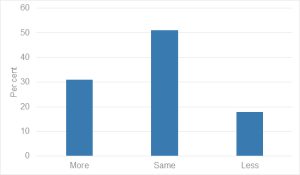
Most commonly teachers in the cohort received the amount of professional development that they expected in the spring term. However, some received more than expected and a smaller group received less than expected.
Figure 3: Is the professional development this term more, less or the same as you had expected?
Source: IES teachers’ professional development journeys research, 2023-2024
Same as expected
For teachers who felt their planned and actual professional development was about the same as they expected, reasons included that their professional development largely stayed the same as the previous academic year, that all staff received the same amount of professional development, that professional development was delivered as a whole school approach and that (in one school) professional development was generally planned a year in advance. Other reasons were that individuals were participating in ongoing (long-running) courses such as NPQs or ECF-based induction. This all meant that professional development was well understood and could be quantified in advance.
More than expected
Those getting more professional development than expected tended to have experienced a change in role or school and noted how this had led to more opportunities. Other reasons included: less COVID-19 related restrictions in place which made accessibility to professional development easier for some, taking up development that other staff were no longer able to do, and schools or trusts wanting to implement new initiatives around professional development, with one doing so due to an upcoming Ofsted inspection.
Less than expected
Limits on staffing availability and funds was one of the primary reasons for professional development being less than expected. Other reasons noted were having commitments elsewhere including marking and assessments, increased teaching commitments and personal development being focused on the start of the academic year rather than throughout the year. One teacher noted how their school had an Ofsted visit shortly before the end of the autumn term and therefore placed a focus on the inspection standards being met, meaning less time for professional development for staff. Another of the cohort felt that they were not offered an NPQ as they were in a part-time role, having recently returned from maternity leave.
Differences within the cohort
The numbers in the research cohort were small but some differences were noticed. ECTs were more likely to report that their professional development had been more than expected, and less likely to report it had been as expected. However, it was those in their first five years of teaching who were most likely to report less professional development than they had expected. This group may need some help around expectations and access (particularly after their induction) to professional development. Those in a low deprivation area[9] were also more likely than others to report professional development had been less than expected.
3.2.2 Meeting needs
Half of the teachers in the cohort felt their current professional development was meeting their needs either completely or mostly, but half felt it didn’t really meet their needs. The findings add depth to discussions in Wave 1 about barriers and facilitators, blocking or supporting engagement in professional development, but also to themes around drivers and motivations.
Completely met needs
Those who felt that professional development completely met their current or planned needs noted that it did so through their school reacting to skills needs, particularly if the request for development was well presented or was regarded as important in maintaining their school’s performance. It was also perceived to have met their needs if it helped prepare them for the next stage of their career, or it meant they were learning new and useful information.
Mostly met needs
Where professional development mostly met teachers’ needs, they felt their access to opportunities was good but that the development itself was often lacking in a certain area; or conversely that the content was good, but they struggled to access it due to constraints elsewhere in their role. Here teachers described struggling to balance training alongside an already pressured workload.
Mixed feelings
Some of the cohort felt that certain types of professional development were prioritised in their schools, with core subjects particularly prioritised. Others noted opportunities ‘slowing down’ since returning from maternity, ongoing issues from the COVID-19 pandemic affecting budgets and school priorities, or that the most useful professional development was too costly (and beyond the budget available).
Mostly not met
Where the cohort felt their needs were not met this tended to be due to perceived limited or no opportunities available (at all or in the areas they wanted such as subject or role specific) or not having the time to access professional development.
Differences within the cohort
The numbers in the research cohort were small but again some differences were noticed. Those working part-time were much less likely to feel their needs had been met (mostly or completely) as were those who had between two and five years’ teaching experience (i.e. just beyond their induction) and those working in a low deprivation area.
3.2.3 Understanding of school management
Just over one-half of the teacher cohort felt that the management in their school understood their professional development needs, either mostly or completely. However, about one-fifth felt their needs were not understood. The teachers explained why they felt this way. The findings highlight the importance of leadership and wider school culture for encouraging professional development and what good and poor practice looks like.
[9] As defined by the teacher
Figure 4: Do you feel the management in your school understands your professional development needs?
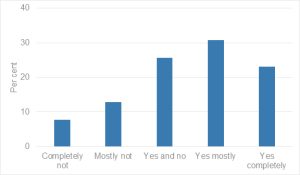
- The teachers who felt their needs were completely understood felt well supported by their management. In some cases, teachers noted how their schools had a specific role held by a member of the school leadership team for continuous professional development:
‘A member of our SLT takes ownership of CPD in our school. She ensures all teachers are developed effectively and evaluates impacts of CPD. I think the fact that she has this role shows that our school understands how important professional development is for our teachers.’
- Where teachers felt their needs were mostly understood they described how their school management listened to their feedback and thoughts and had made efforts to accommodate staff’s changing professional development needs. One teacher also noted how regular mid-term reviews of performance management acted as a way of assessing where professional development may be needed amongst staff.
‘SLT have made an effort to introduce an “aspiring middle leadership” course in response to staff feedback.’
- Some teachers felt their needs were only partly understood and described how their schools chose the professional development for them, or that the subject of professional development was rarely discussed. Whole school approaches to professional development were also mentioned (as noted elsewhere, this was not seen as particularly effective), and in some cases confusion amongst SLT or changes in staff within the SLT meant that professional development was not consistently delivered or discussed.
‘I think the new senior team means everyone is fighting to get their stamp on things. This means it’s convoluted and with so many changes it’s tough to keep track of all the things we’re meant to be doing.’
- Teachers who considered that their needs were not understood, felt that their opportunities were limited due to the cost of professional development and the time it would take to access it. They also described how no one in their school checked in with them about professional development, that the opportunities on offer were not appropriate or useful to them, or how they felt they did not receive the same opportunities as others.
‘Having children and being part-time due to childcare has massively impacted my career development. I am one of the longest serving at the school but have not been approached to be developed further whereas colleagues have been developed, not based on performance, but in order to retain them at the school.”
3.2.4 Looking to the future
The teacher cohort were asked whether at this stage in their career and working life would they like more professional development opportunities. The majority (three-quarters of the cohort) wanted more professional development.
More development
Generally, those wanting more professional development wanted to expand their skill sets in some way and to further their careers. For example, several of the cohort wanted to explore leadership development with a view to moving into leadership roles in the future. Others wanted to develop their subject specific skills or wanted professional development that aligned with their personal development goals. Additionally, continual development and ongoing learning was seen as important. Here teachers talked about how it was good practice to learn new things. Staff who had more teaching experience generally felt that they had become ‘stagnant’ in their career or that their school did not develop more senior serving staff in the same way as early career teachers.
‘I am in my fourth year of teaching and so I am still wanting to engage in lots of CPD to ensure my teaching improves. I have become a head of department this year and so I want to continue to develop my people management skills.’
‘All educators should continually be strengthening their practice for optimal student experience and learning.’
‘As my career has developed, I have observed older staff not being developed in the same way.’
No further development
A small number of the cohort felt they didn’t want any further development (beyond the development they were already engaged in). Here teachers noted that taking on extra professional development opportunities would either overstretch their current role or interrupt their current work/life balance. For example, one teacher working part-time with a young child was not prepared to take on any more responsibility or workload while their child was still young. Another felt that ‘work/life balance is also crucial’ and that ‘too much could be saturation.’
Unsure
Another small group were unsure about whether they wanted more professional development at this stage of their career. One part-time staff member wanted to focus more on their family so was not actively looking for professional development opportunities. Another felt confident in their teaching abilities but noted how they didn’t want to stagnate in their career. Two ECTs felt that their induction programme and day-to-day experiences were enough professional development at this stage in their careers, but they would be open to opportunities if they were subject specific.
Differences within cohort
The size of the cohort was small, so the findings are indicative only but do suggest some themes. Those most likely to want more professional development were those with two to five years’ teaching experience (i.e. just beyond their induction), followed by those with at least ten years’ teaching experience. Those least likely to want more professional development at that point in their career and life were those mid-career (with five to ten years’ experience) and those undertaking their statutory induction.
Those working full and part-time had similar proportions who wanted more professional development (generally the bulk of these groups), however those working part-time were more likely than those working full-time to say they would not like more professional development opportunities at this stage of their career. This could reflect their decisions around working pattern and considerations of work/life balance. However, it indicates that most of those working part-time do still want more opportunities for professional development. Those in low-deprivation areas were more likely to report wanting more opportunities than those in high-deprivation areas – which follows other patterns and perhaps suggests that those in low deprivation areas feel they are not getting as much focus/support for development as they would like. Those in secondary settings were more likely to want more professional development opportunities than those in primary schools.
3.2.5 Suggestions for change
The cohort provided their thoughts about professional development for teachers in England. Many of their comments focused on how they felt professional development needed to change going forwards. They called for:
- Professional development to be valued and felt that professional development had been declining in value over time.
- Professional development to be more personal and felt that at present professional development focused more on school improvement and whole school development rather than on the individual.
- Consultation and felt that staff should be consulted and listened to, in order to identify areas for development, which would in turn improve practice.
- More time for professional development, particularly during school hours.
- Professional development to be meaningful, otherwise they felt it would just unnecessarily add to the already high workload.
3.3 Further reflections on effective professional development
3.3.1 Teaching techniques
A wide range of teaching techniques were experienced by the teacher cohort, and many reported experiencing several techniques.[10] The most common (experienced by at least half of the cohort) were:
- Short modules.
- Observations.
- Varied presentation styles.
- Reflection.
- Feedback.
[10] Two-thirds reported at least five techniques
Figure 5: What teaching techniques have you experienced this year?
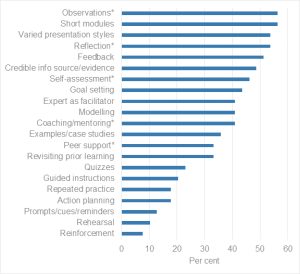
Note: *indicated as most effective
Source: IES teachers’ professional development journeys research, 2023-2024
Most effective
Teachers were asked what teaching or training techniques they had found most effective in their experience of professional development. This was an open text question, and the most effective techniques were identified as:
- Self-assessment – this allowed them to identify where they had gaps in their knowledge, as well as acting as a reminder to ‘check in with yourself’.
- Reflection – this provided opportunities to develop good working practices and identify what could be improved.
- Coaching – this helped them to explore new ideas and develop and achieve goals.
- Peer support and observation – this support plus being able to experience ‘tried and tested’ methods were seen as invaluable, as was the opportunity to be evaluated by a ‘safe observer’, gaining personalised feedback, and seeing others’ viewpoint(s).
- Expert facilitators – this gave access to experienced teachers and subject experts who could provide examples of good practice and use case studies to help contextualise and embed learning.
Least effective
Whereas the techniques they identified as least effective included anything lacking in clarity or relevance but more specifically included:
- Observations – some felt that this was subjective, so the feedback was less meaningful, it was also felt to be less useful if the observer was not a subject specialist, and for some teachers observations were experienced as added pressure.
- Goal setting – this could be seen as a ‘box-ticking exercise’, and challenging to do particularly where the context is constantly shifting or where you have limited time to work on them.
- Presentations – these could be dull, could involve presenters trying to fit in too much information, some felt sitting for a long-time was difficult, and there was a preference to learn by experience.
- Theory-based techniques – these were considered ‘hard to digest’, and there was a desire for real world examples and applicability.
- Online sessions – these were often regarded as less effective than face to face sessions.
Observations were seen as among the most effective techniques experienced by some teachers but among the least effective by others. This indicates how some techniques worked well for some but not for others.
The following comments provide further illustration of the techniques, and importantly the combination of techniques, they found most effective and also least effective:
‘Having an expert SEND teacher share her experience and strategies during the zoom webinar was really helpful. She gave us recognised strategies that can be tailored to our own classes and language learning.’
‘Having professional discussions with a fellow experienced teacher is extremely effective. We have been able to carry out joint observations, ready case studies together, plan teaching sessions, design training sessions for other support staff in the school – all of which have been so much easier when doing it alongside another teacher.’
‘The most effective has been peer support and reflection as having a colleague come and observe is safe and allows you to teach in the same style that you teach normally (not nervous) and reflection because in a busy job it is quite rare to actually reflect on your teaching practice and change the ways you are stuck in.’
‘As I am new to the profession the coaching, rehearsing and repeated practice have been effective in improving me as a teacher.’
‘When it is a whole days’ training, where we are spoken to, I tend to switch off more. The most useful training is when it is in small groups and focusing on something specifically relevant to me.’
‘Nothing has been revisited, I haven’t been observed, I want to observe some of my department but many don’t feel comfortable with that or it’s difficult to find the time. We have been told to look into our questioning techniques and checking for pupil understanding but it’s unclear how I know what to improve/work on with no mentoring or reviewing.’
‘Goal setting is something that doesn’t work for me. I find the initiatives need the right environment to try and that environment varies day to day and even term to term.’
‘Observations as personally I find these very intimidating and hate a variety of people coming to watch and judge my teaching.’
‘I don’t like it when they just read through a PowerPoint because I get bored and switch off’.
‘Reflection on targets I have set myself purely because I had to set them, not because I find them remotely helpful to my teaching.’
3.3.2 Features of effective professional development
The teachers described the features they felt made professional development most effective, essentially what makes for good quality professional development (which was also explored in Wave 1). These were:
- Tailored: Here it was noted that when teachers’ professional development needs were listened to this allowed for professional development to be tailored and to be responsive to their needs at given points. ‘One size fits all’ approaches to professional development with whole school delivery were felt to be less effective. The teachers in the cohort appreciated the autonomy to choose what development to be involved in, and this indicated where their true interests may lie.
- Evidence-based: The use of research, theory and having experts deliver professional development were also described as effective features. Examples demonstrated through real case studies were thought to be very effective, as were experts who could provide additional resources such as handouts and PowerPoint slides.
- Practical and subject focused: Teachers particularly appreciated ‘hands-on’ approaches to professional development, and subject specific development rather than generic school-wide programmes and activities.
- Mindful of wider commitments: Several of the cohort noted how they appreciated shorter sessions, as they found these were easier to fit around other commitments. Indeed, the most common effective feature of professional development noted was that it should have low impact on other areas of the teachers’ workloads. Sessions less than an hour in length were felt to be easier to take in, and individuals felt that sessions should take place during in-school hours to ensure that staff are able to have a healthy work-life balance.
‘When staff get to choose what they wish to pursue, this means they are passionate about it, and it allows them to develop.’
‘I feel that the most effective way is to work alongside the individual in partnership to develop the persons strengths. I think this helps with wellbeing, feeling seen and appreciated and would work to retain teachers within the profession as unfortunately it feels like the more experience/more expensive you are means that you can often be ignored or not developed anymore.’
‘Expert research presented as a mini lecture with a handout for us to take away and reflect in our own time.’
‘Courses and training that takes research and theory but demonstrates it in a practical way that can be applied directly in the classroom are the most beneficial. Teachers are extremely time poor and overwhelmed with the amount of changes happening all the time in education that they do not have time to digest educational research.’
‘It is most effective when it does not impact on workload and work/life balance (e.g. I frequently had to work in the evenings on my NPQ, which was difficult as I have a young family).’
3.4 Impacts of professional development
The teacher cohort reflected on the impact of their professional development over the year. This was asked as an open question so the teachers could describe the impact (if any) in their own words. It was then asked as a closed question to identify where they felt their development had had an impact but also the strength and direction of the impact (whether positive, negative or neutral).
The outcomes, changes or impacts their professional development had – on them, their pupils and their school – were described as follows:
Impact on teachers – improving teaching ability: the impacts largely centred on increased confidence in their teaching abilities, their ability to deliver new topics or to use different or new teaching styles. The cohort also described how their professional development contributed to the ongoing development of their role, and this was especially the case for ECTs. ECTs felt that undertaking new tasks throughout their induction programme was helping them develop further as a teacher.
‘It has helped me grow in confidence in teaching abilities which has helped me to feel strongly about what I can achieve for my class and support within school.’
‘As I get observed and given feedback every two weeks, I am regularly changing and adapting my teaching practice. I would say the impact has been small, gradual changes, which over half a year has made a big difference. For example, my observation focus was metacognition, this has then improved my use of metacognition in the classroom based upon the feedback.’
‘I have grown in confidence and am more at ease when being asked to try something new. For example, practicing entry routines and expectations in my coaching sessions, but putting it into practice and repeating it until it works has had a big impact on my teaching.’
‘I have been able to stretch and challenge students further due to me being able to ask questions effectively and cold call effectively.’
Impact on pupils – being responsive: Here the impacts described were about meeting the different needs of their pupils (which were recognised as wide ranging) and using adaptive teaching. For example, one teacher described altering their lesson planning based on their class’s different needs, whilst another was adding different forms of assessment to accommodate different learning styles. Needs outside the classroom were also discussed with awareness of disadvantage and vulnerability, and self-harming and suicide prevention.
‘Self-harming and suicide prevention [training] has helped me to recognise signs and symptoms in students, especially looking out for them within my tutor group.’
‘CPD surrounding year 11 assessment grades has meant that students now have more of an awareness about their predicted and target grades. Students have been given grade cards where staff have been able to complete these for their subject. The students I teach are now asking me what they need to do to achieve their target grade. This has made lessons better because students are taking some responsibility for their outcomes and because their exams are approaching, they are starting to take their learning more seriously.’
‘I definitely think the training I’ve received has given me the opportunity to reflect upon my teaching and how I can be better. I believe that the maths training I’ve received has given me the opportunity to think outside the box when it comes to maths teaching, and I think that the children have been impacted by this in a positive way.’
‘We have had some CPD on retrieval tasks and developing vocabulary, so I now start most lessons with these types of tasks. I would say that the “overlearning” has helped the pupils in my class to retain information.’
Impact on the school – supporting curriculum change: The broader impacts of teacher professional development on schools were also discussed, particularly around developing the curriculum so that it was better linked to other subjects, and also developing shared resources and making better use of resources within the school.
3.4.1 Positive and negative impacts of professional development
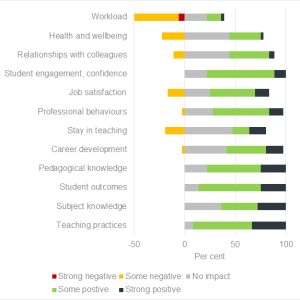
Overall, the teacher cohort reported a range of positive impacts from their professional development. These were most commonly a strong positive impact on teaching practice, on pedagogical knowledge, on student outcomes, and on student engagement, participation and confidence. It also had a positive impact for many on subject knowledge, professional behaviours, job satisfaction and career development.
For some of the cohort their professional development had a negative impact. It negatively affected health and wellbeing, retention, job satisfaction and relationships with colleagues. The most commonly reported negative impact was on workload, and here the negative impacts of professional development outweighed the positive impacts. This negative impact on workload was most likely to be reported by those working full-time and by less experienced teachers (with one to two years, or three to five years’ experience). As the size of the cohort was small these patterns are indicative only. In engaging with professional development, the cohort recognised that it would increase their workload and so this may be a key part in their decision-making around whether to seek out or engage in professional development.
Figure 6: Has the professional development you had this academic year had any impact on the following?
Source: IES teachers’ professional development journeys research, 2023-2024
4 Wave 3 findings
Semi-structured interviews in the 2023 summer term with 33 teachers from the research cohort again updated experiences of professional development and explored the extent to which professional development was delivered externally and focused on opportunities for development around mental health and wellbeing and for SEND (both areas raised in earlier waves for more or further professional development). This wave of the research also investigated the importance of professional development, what supports engagement in professional development and potential drawbacks; and the changes in the volume and nature over their careers and looked to the future in terms of what professional development was planned and what teachers hoped for.
4.1 What professional development are teachers getting?
Teachers in the cohort described the professional development they were undertaking in the 2023 summer term. Their recent development tended to be internally provided (and thus followed findings from the autumn and spring terms). Few reported externally provided or delivered training, and teachers noted how they sometimes missed the exposure to a wider range of views and ideas gained through externally provided training and development.
‘Potentially the drawback to the internal-focused CPD model that we have is that we tend to feed off each other, there is not always scope for new ideas coming from the outside in.’
Their professional development tended to be focused on their teaching role and school-wide priorities or on their teaching subject. The former was often instigated by the SLT (or even the wider Trust) to address school-wide issues, as part of longer-term plans or resulting from an Ofsted inspection. If subject specific this tended to be instigated by departmental leads. Some reported more general career development, to support progression to leadership positions or to take on positions of responsibility. However, few ‘career conversations’ were happening and only a small number of teachers described discussing professional development needs with their line managers in one-to-one meetings. There was a perception that professional development to support career progression was something an individual would have to seek out for themselves and indeed some teachers described finding opportunities themselves.
4.1.1 Recent internal professional development
The internally provided development or training described included:
- General subject training from staff members in school for example training focused on the curriculum or on specific aspect.
- Staff meetings involving the whole school, generally once a week and focusing on different topics.
- Regular departmental professional development generally focused on approaches taken within the department, and relevant subjects (e.g. inclusive teaching of Modern Foreign Languages (MFL), speaking exam preparation).
- Year group meetings (e.g. moderation for SATs[11]).
- Others such as in school coaching, shadowing, observations, informal conversations among staff, pedagogical book club.
They also noted how there was some form of feedback from wider professional development in the school and sharing of learning (from those who had participated in training) built into their normal workdays, through formal meetings or informal sharing with colleagues.
These internal training and development experiences covered a range of topics.
[11] The acronym for Standard Assessment Tests, these are optional at the end of key stage 1 (from 2024) and mandatory at the end of key stage 2 (Year 6). They are used to measure school performance and put in place support for individual students. https://educationhub.blog.gov.uk/2023/05/04/when-are-year-6-sats-2023-key-dates-for-parents-and-pupils/
| Examples of internal professional development topics
Safeguarding, vulnerability (understanding what vulnerabilities are), fire-marshal training, assessment, vocabulary and oracy training to help pupils, how to deal with difficult situations and classroom management, contextualised learning, rigour and pace in lessons, retrieval and questioning, metacognition, ‘ghost learners’, developing a School Improvement Plan, school policies and systems (e.g. suspension proto-cols, data collection), diversity and inclusion training (e.g. ‘No Outsiders’ programme), supporting attention deficit hyperactivity disorder (ADHD) pupils, autism seminar, teacher toolkits, outdoor activities, communicating with parents, leadership development. |
4.1.2 Recent externally provided development
Examples of externally provided professional development the teacher cohort had experienced included in-person courses and conferences, ECT focused development involving both in person and online sessions either as part of their ECF-based induction programme or additional support such as coaching and walk-throughs, and online training. Again, these covered a range of topics.
| Examples of external professional development topics
NPQs, subject specific courses (e.g. use of technology in Maths lessons, MFL), Philosophy for Children, writing course, Black Educators conference, New Teachers conference, pedagogy course, self-harm and suicide awareness, mental health and anxiety in schools for children, teacher educator programmes, leadership. |
4.2 Professional development activities at the school
The teacher cohort also discussed more broadly professional development at their school, with a focus on externally provided opportunities, mental health and wellbeing activities, and SEND focused development, and also what helps with engagement in professional development.
4.2.1 Externally provided professional development
Despite most of their current development being internally delivered or facilitated, many of the teacher cohort felt their school had links to external resources and professional development opportunities. These links included their trusts (for those in schools which were part of multi-academy trusts), local authorities or local borough councils, subject groups formed across several schools, local and national external experts and providers (e.g. The National College, Tes) and providers offering formal courses and qualifications such as NPQs. However, some teachers reported very little or no external links to professional development opportunities, noting how their schools preferred to offer in-house training and development (at least recently) or that they were unaware that any external provision was available.
Trusts or school alliances appeared a key source of external links and development for their schools. They provided professional development through visits to schools, developing partner schools (within the trust system), bringing subject teachers together, bringing all staff together (on INSET days), provision of online training for all schools in the trust, hosting meetings, sharing good practice, and providing a platform for sharing resources (to spread the cost/for cost savings). One teacher noted how they view their Trust as a safe space for teachers to support each other. Others were more critical and felt that external development meetings (off school premises, at another school) were not prioritised or only available to senior staff or that opportunities to share practice had reduced during and since the COVID-19 pandemic. The feedback suggests that the frequency, format and access to professional development facilitated through trusts varied widely.
4.2.2 A focus on mental health and wellbeing training
The teacher cohort were specifically asked whether there was any mental health and wellbeing development or training in their school. Only a minority of the teacher cohort reported personally receiving any mental health and wellbeing training. Where this did happen, it tended to be included as part of the induction for ECTs, to deal with a specific situation such as training to manage grief after the death of a colleague, or to train staff to deliver interventions for pupils (and thus pupil focused). More specific examples were working with Bloom[12] (as a partner school) to provide a mental wellbeing course for children, and a talking therapies training session for staff. Those who didn’t have any specific training felt it would be helpful to have it.
There were other examples given of mental health and wellbeing activities or support more broadly within their schools (or that were planned), aimed at staff and at pupils:
- working with pupils to discuss friendships and being positive and helping pupils see what they have learned;
- regular safeguarding sessions to discuss updates about mental health;
- having a mental health lead who identifies targets for the year;
- having mental health ambassadors with a focus on different aspects (e.g. relaxing, learning a new skill, being active, promoting family and friendship time) and a budget to work with staff;
- having a wellbeing portal for staff that provides links to resources;
- staff wellbeing surveys;
- inclusion of work-life balance in the school development plan;
- planning for 2 staff wellbeing days from next (academic year); and
- devoting some staff meetings to wellbeing.
The teachers recognised and discussed the benefits of mental health and wellbeing training and activities. However, some activities such as providing access to resources via a platform or staff surveys were not considered very helpful.
[12] Bloom is a UK-wide programme for 14-18-year-olds focused on supporting young people’s mental health resilience. It is delivered in schools and colleges. It is delivered in schools and colleges across Northern Ireland by MindWise. See https://mentalhealth-uk.org/partnerships/projects/bloom/, and https://www.mindwisenv.org/what-we-do/mindwise-services/children-and-families/bloom/#:~:text=The%20Programme&text=Bloom%20equips%20young%20people%20with,to%20university%20or%20starting%20employment
4.2.3 A focus on SEND training
Around one third of the teacher cohort reported SEND training in their schools, and for this group the training was provided by or aimed at SENCOs or provided by a combination of internal and external experts. Examples of SEND training included SENCO visits to a specialist centre focused on communication, provision of training for new staff from the school SENCO, all staff completing a Level 1 Autism awareness course, specialist external agencies delivering sessions during teacher development days, support from an Educational Psychologist (on a case-by-case basis), and sessions delivered by the local council or borough.
Teachers with no formal SEND training or development activities in their school noted how they would welcome this.
4.3 The importance of professional development
The teachers in the cohort considered professional development as important to their careers and to their skill development (reflecting the drivers and motivations discussed in Wave 1). They also recognised that professional development encompassed a range of activities from formal to informal. In terms of skills development, professional development was important (and beneficial) to support the following:
- Helping them to develop their role, their professionalism and to further understand what being a teacher is. Professional development also meant learning and improving their skills, potentially for helping them to progress in their career at a later stage. Some noted how that this was important as teachers are under scrutiny; thus, learning new skills or different ways of teaching was felt as necessary.
- Helping them to become a better practitioner so that they could do the best by their students, learn what works, and evolve their practice to meet pupils’ needs. Thus, professional development was seen as important to support students and their education experience and outcomes, and to understand the best tools or strategies to use in teaching to ‘get the best’ out of students.
- Updating teaching practice and knowledge in recognition of constant developments in teaching theory and practices, the profession, and the curriculum (in general and also specific subject areas). Professional development provided access to, and the opportunity to understand, the latest research, techniques and practices.
- Improving confidence in their skills.
- Providing a space to practice and refresh techniques and reflect on their practice.
- Providing opportunities to learn from and collaborate with other teachers, especially those with more experience and potentially those working in similar or different settings.
This feedback again highlights where professional development has an impact – on the teacher and their practice, their peers and the wider teacher community, their students and their schools.
4.3.1 Drawbacks in professional development
Professional development was regarded positively; however, the teachers in the cohort recognised that there could be some drawbacks or negative impacts (expanding on the negative impacts explored in Wave 2), which could also act as barriers to engagement (adding depth to the barriers explored in Wave 1).
- Supply cover: a major drawback, especially to external training, was the need for schools or teachers to arrange for supply cover. Teachers reported how this could be ‘more trouble than it was worth’ and described both having to set the work and then to ‘mop up’ afterwards (for example needing to re-teach the set work as it may not have been taught as planned, and teachers were aware that children may behave differently when supply teachers are used). The other concern was that supply teachers are costly for the school but may not provide the quality cover required.
- Cost: as well as the cost of organising supply teaching for external training and development, participants also commented on the costs of courses. They felt these were becoming ‘over-priced’ and ‘prohibitive’ for some schools or departmental budgets. This could make training restrictive – both in terms of the type of training schools could opt for, and who would be considered eligible to attend.
- Time: the time needed for training was seen as another drawback as it meant either spending time away from the class or required time outside of working hours to undertake the training (if not timetabled in). Teachers also noted how some internal training was delivered at short notice. Poor timing also meant that there was little time for reflection on the training and development received.
- Pitch: the level that the training or development is ‘pitched’ at could also act as a drawback. Some teachers felt that whole school training was not effective as this tends to be pitched at one level whereas staff have different skill levels, for example some may find the training patronising and may not listen or participate. One teacher noted how, in whole school training, they felt dictated to rather than fully engaged.
- Quality: it was recognised that not all development is of good quality which can be off-putting and disengaging and could potentially provide conflicting advice. Good quality development was regarded as providing practical take-aways, involving interactive elements, delivered by a credible and enthusiastic facilitator, based on high-quality research; and respectful of time and tailored and relevant (reflecting findings from Wave 1).
4.3.2 What helps with engagement in professional development?
The key facilitators to engaging in professional development – to counteract some of the barriers and perceived drawbacks – were reported by the teacher cohort as:
- Protected time and budget.
- The convenience of online sessions (for some).
- Face-to-face sessions.
- Making professional development part of the school culture.
- Timing professional development for least disruptive times of the year and avoiding ‘pinch-points’, although this could differ and what one teacher would consider a good time another might not. For example, some called for no training in the last half term as teachers need their time and energy for other activities such as parents’ evenings; where others felt the end of the year is better as they have more time.
- Making development accessible for those working part-time or with caring commitments.
These points are illustrated by the following quotes.
‘The switch to online has been huge – so convenient. A planned and reasonable timescale helps. If face to face, it helps if the person [trainer/facilitator] is good quality.’
‘If the and having some protected time for professional development, especially for newly qualified teachers and ECTs. Motivation to speak with likeminded people and having protected time has helped engagement with professional development.’
‘The Head and SLT are good at giving us time out of class if we need it and providing cover. If a supply teacher is booked in for a half day, the deputy can book for a full day and tell staff to go over folder. It’s scheduled into school so every few weeks different teachers will get times out for specific subject.’
‘When we do have training, we get a lot of buy in from staff. I’m very careful about when I schedule training. I schedule a lot in September and then back off, then put more on in January and then back off again.’
4.4 Changes in professional development over careers
4.4.1 Change over career journey
Professional development appeared most important (and arguably most accessible) at certain points in individuals’ career journeys:
Early stages
Professional development was considered fundamental when starting out and when individuals are new to the teaching role. It was noted how ECTs received a great deal of targeted training and development along with dedicated timetabled time to do so. This reduces over time, as ECTs gain more experience and move beyond their induction period (and beyond their timetabled development, thus making engaging in development ‘more of a time management challenge’).
When making a transition
When moving to a new role or new school, professional development helped with meeting new challenges and having the necessarily skills and understanding. Some teachers noted how they experienced more professional development than they had expected, and this was because they had moved roles.
When advancing in seniority and heading towards or moving into leadership roles
This might also involve training others. Some teachers felt that the senior leadership team received more professional development, and so other staff ‘are left plodding along’ which can lead to feelings of dissatisfaction.
But also important throughout careers
Beyond these key points, it was also seen as important throughout careers to avoid being left behind in terms of current practice and knowledge, and also to help stay connected to the profession (to stay in teaching). It was felt that professional development provided opportunities (beyond career progression, skill development and confidence building) in terms of networking – to be able to have a dialogue with others in the profession, discuss issues and to be collaborative. These discussions again reflected the individual drivers and motivations to seek out and engage in professional development.
Some of the cohort felt the volume of professional development available to them had remained relatively consistent throughout their career, highlighting the expectation that teachers will continue to learn and develop. However, some teachers noted how they had not been given much opportunity to engage with professional development. They were frustrated as they felt there would always be aspects of their practice they could improve upon, and it was important for networking and team development and for career development. Those who reported little or no access to professional development (or little choice over the type of professional development their received) also felt it limited their career progression opportunities. This led to teachers feeling ‘left on their own’, ‘stuck’ in their career and unvalued and unsupported by their school.
The cohort also discussed how the nature or focus of professional development changed over their careers. In earlier years it tended to be more generic training (for example marking, feedback, and behaviour management) but as individual careers evolve development becomes more specific (for example, focused on their subject) and this was considered more meaningful and a better use of their time.
4.4.2 Change over time
The teachers reflected how the volume and nature of professional development had changed over their time in teaching. They felt this was influenced by funding levels, school culture and commitment, and changes in the wider environment.
- Reduced funding in the sector over time led to fewer opportunities for external formal training courses and limited opportunities to a small number of staff, and led to a greater focus on internally provided development and online provision.
- Some schools were considered more proactive than others. These had professional development leads, career conversations were occurring, the senior leadership team were perceived to be invested in professional development, and they could be part of a trust where methods were shared.
- Some of the cohort felt that recently, since the COVID-19 pandemic, development appeared to be more dependent on individuals wanting to invest in their own careers (and seeking out development themselves and engaging in their own time).
‘When you start as NQT, there are a lot of ECT training courses so more CPD available. Then slowed down but more specific. Covid had a massive impact and now we’re slowly building up with the CPD. There was more time for CPD during Covid because we were teaching at home.’
‘Over last few years, more thought put into career development, more of a pathway. More opportunities to be accredited as lead practitioner. Course for aspiring middle and senior leaders.’
‘Professional development was more available when I first started as NQT. School has less and less money, so they really pinpoint who they put on professional development courses. The volume of professional development opportunities has become less and less across my career.’
‘Nature [has changed] absolutely. Generally entitled to go on one course a year ten years ago but this has eroded due to funding. Now purely in-house or opting into free webinars. Volume has decreased – some colleagues in department have never been on an external training course in [the past] five years.’
4.4.3 Desire for future professional development
There was a desire for more or at least some professional development for the future (reflecting the findings from Wave 2) and for this to be focused, well planned and timed.
What teachers hoped for
Development to meet their own professional goals
This was most commonly development related to teachers’ own professional goals. For example, training for aspiring subject leads, mental health leads, assistant headteachers, other middle leadership and senior leadership (this could involve NPQs). One teacher mentioned an interest in safeguarding (at level 2 and 3). A few of the cohort reported they had leadership development planned for next year involving NPQs or coaching.
Subject-specific training and development
This was followed by subject-specific training and development to increase subject knowledge. In general, teachers wanted more training in the subjects they were already teaching but one teacher mentioned wanting to branch out from maths to teach other subjects, such as literacy. Again a few (not many) of the cohort reported planned subject-specific development, but this tended to be maths-focused.
Other specific areas
Other areas for future development were focused on specific skills; this was often SEND training and development. Teachers wanted to see this as something that could be timetabled and not something they would have to seek out on their own. One teacher was also interested in delivering SEND training to other staff in the future. Another area mentioned was behaviour management. These areas appeared not to feature in the planned professional development reported by the teacher cohort.
Visiting other schools
A few teachers were specifically interested in visiting other schools to observe and compare practices.
What was planned?
Where the teacher cohort reported what professional development they had planned for next year, this tended to be either statutory training (for example, safeguarding or first aid) or more informal (for example, sharing knowledge in meetings or assemblies). Many teachers didn’t know what professional development would be available to them next year. This was either because the plans were not communicated to them by the school or because they were planning a change (for example, moving school or taking a break from teaching).
5 Wave 4 findings
The final wave of the research involved an online workshop in the 2023 autumn term with 13 teachers from the research cohort attending.[13] The 90-minute workshop involved two breakout discussion sessions. In the first session the teachers reflected on their professional development journeys across the whole of the year of the study (October 2022 to July 2023) and looked forward to what professional development would like in the future. In the second session the teachers considered and discussed the approach to professional development in their own schools.
[13] The whole cohort were invited and were polled for a preferred date and time to enable as many as possible to take part in the live event.
5.1 Reflections on professional development across the year
The teachers described a wide range of professional development and multiple, often simultaneous, experiences of professional development over the year including formal and informal. Many were positive about their experiences. However, a couple were less positive, finding their development repetitive or not specific enough for them.
Much of the professional development described was internal, delivered within the school. For one teacher this was a more recent change, associated with the school becoming an academy. Internal training and development was often viewed positively, as it was felt to allow for better tailoring to need. One teacher noted how in-house delivery was a deliberate move in order to utilise in-house skills, identify and plug gaps and thus tailor the training for the school and individual staff. Another teacher felt in-house training was better than externally provided professional development as it was customised and specific, and ultimately aimed at raising pupil attainment in the school.
When reflecting on the volume and nature of professional development experienced, two (related) themes emerged: the degree of tailoring and equality of access.
- For some, the professional development received was considered more generic and aligned with wider work in the school (e.g. a focus on mental health). However, for others, their development was more personal and focused on their own development needs. This could relate to moving roles (creating specific development needs). There was some feeling that professional development should be more tailored, as whole school professional development may not be efficient or useful for all staff. This reflected a recurrent theme across all four waves that whole school development was less effective and perhaps less welcomed.
- Some were concerned that they had limited access to professional development that aligned with their own goals or needs. One teacher noted that for more specific and tailored professional development it depended on ‘who you are’, suggesting that such professional development was rationed and not available to all. This was echoed in the experience of another who noted how they felt ‘fobbed off’ and kept getting excuses from their school leadership team for not being able to go on the course they wanted. This made them feel they were not very worthy. It was noted that professional development, whilst being specific to individuals’ needs, also needed to be more creative and inclusive.
5.2 Impacts of professional development
The teachers in the workshop reflected on what difference their professional development experiences had made (building on the findings in the previous waves). The impact was felt to depend on three key factors:
- The quality of the professional development: this in turn was related to a number of factors but the highest quality development tended to be externally provided and face-to-face, specific and evidence based.
- The volume of training and development and how this balanced with workload and wider commitments to avoid being over- or underwhelming.
- The timing, with time before to plan, and time afterwards for implementation.
‘Schools can be too quick to “get on a new thing that is just coming out”, and when you throw lots at a teacher, they tend to end up doing none of it, because it becomes too overwhelming and people do not know where to start… When training is good it is amazing, and when it is mediocre it becomes forgotten about.’
‘Every week they may have a CPD on a topic that is completely different, and then there are actions following the CPD every week and they may not have had time to do those actions, and then they are hit with another topic with more actions, and it all gets added to the bottom of a very long list of actions.’
‘When professional development is good it feeds into [improved] classroom practice but when it is done badly it creeps into a workload problem.’
Some specific examples of improvements in practice resulting from professional development were described:
- One teacher noted how development focused on different types of feedback involved both theory and practice on how to carry it out, which meant they could see what could work and why, and were able to make use of the tools they learnt.
- Another noted how the SEND training in their school had led to improved information sharing and management (e.g. class chart system), and the focus on adaptive teaching skills had led them to give more thought to celebrating neurodiversity: ‘We have umbrellas outside the school to show everyone comes under the same umbrella’.
- Another noted how professional development around behaviour management had helped them ‘most of the time’.
5.3 Looking to the future
In reflecting upon and describing the professional development they had accessed over the year, some of the cohort noted what was missing, suggesting areas of professional development they would have liked or that would have enhanced their experience. Others specifically described the type or focus of professional development they would like for the future.
5.3.1 What teachers would like to see
Looking at practice and focus within other schools
A key recurring theme was looking at the practice and focus within other schools. One teacher described how several years ago they had attended a teacher and learning programme that took place over several months and brought 6-7 schools together. They visited each of the schools and would talk about what they felt they were best at or ‘exemplars’ of, and would discuss how it could work in their own schools. It meant they were out of class once every three weeks, but they found the experience ‘amazing’. Another noted:
‘Going to see something in practice is the best CPD that can be offered…see one, do one, and get the help to get through it…some of the best CPD has been going into another school, working with other departments and learning and troubleshooting ideas… to go and see where something is being done really well is essential’.
A focus on pupil needs
The second theme that emerged was about putting pupils’ needs at the heart of teacher professional development:
‘It would be better to look at something that all teachers are looking at collectively, and how it would work across the school, and what will have the biggest impact for the students.’
SEND professional development
The third theme related to SEND professional development. Teachers in the cohort described seeing more children with behavioural needs and additional needs, and not feeling able to meet their specific needs or giving them the correct provision. They were concerned that children with SEND will get left behind. The teachers felt it would be helpful to see what good practice looks like through visiting other schools, but that it would need to be properly resourced to allow them to take time out for visits. One teacher noted how they had set up visits but had to cancel them due to a lack of cover.
5.3.2 Challenges for professional development
The challenges for professional development were also discussed when thinking about the future. The teachers in the workshop noted how the general backdrop of increased pressure in the school system, changes in structures and governance, and reduced budgets all affected professional development. One teacher noted how staff absence had increased which meant all teachers in the school had taken on more roles and responsibilities which made professional development challenging. Another noted how budgets had ‘dried up in school, most is absorbed into department budgets now’ which affected the ability to release staff for professional development. Another noted how their school used to have a training hub and would work with other schools but now that the school was an academy the training had become internal.
5.4 Perceptions of good practice in schools
The cohort considered the approach to professional development in their schools. Their perceptions of the approach taken differed by their own level of seniority and thus their involvement in school decisions and planning and their ability to influence practice around staff development. This suggests that within a school there may not be a shared vision of what happens in the school.
Several aspects were discussed:
- when development happens and that sometimes this happens in teachers’ own time;
- having encouragement from the head, SLT or head of department, and an approachable leadership team;
- recognising achievement, and listening to/respecting staff expertise and staff ideas; and
- whether development is in-house (and thus leveraging internal expertise).
Good practice or a positive approach to professional development was associated with an individual having control over their development, recognising expertise, sharing learning, and making resources available. Positive practices described, which could take place across the school or just within specific departments, included:
- a coaching programme in the school for every member of staff – the school has a team of coaches to observe lessons every half term and they encourage reflection on teaching;
- regular meetings led by middle managers (rather than the SLT), with the agendas set at their discretion;
- peer reviews where teachers from different disciplines observe lessons and give feedback;
- staff being given freedom over what they categorise as their own professional development and having their own individual development pathways (rather than a one-size-fits-all approach);
- encouraging sharing of learning and expertise through cascade sessions, during staff and curriculum meetings and mentoring, and emphasis on best practice;
- having an open door policy and supportive culture – it was felt that support structures can break down when they are dictated by SLT; and
- a focus on growing talent within the school.
The teachers recognised that there was also a time and place for more directed (rather than self-steered) professional development. This could be to support new staff, to deal with organisational change or crisis, or to deal with a wider issue such as a high proportion of pupils with ADHD. This could be seen as authoritative, but also strategic and about giving and setting direction.
Appendix A: Cohort characteristics
Table 1: Demographics of teacher cohort
| Category | Group | Achieved number |
| Age | Aged 20 to 29 | 18 |
| Age | Aged 30 to 39 | 15 |
| Age | Aged 40 to 49 | 6 |
| Age | Aged 50 and above | 1 |
| Gender | Female | 31 |
| Gender | Male | 9 |
| Ethnicity | White | 32 |
| Ethnicity | Ethnic minority | 8 |
| Total | All | 40 |
Note: This information was captured at the start of the study
Source: IES teachers’ professional development journeys research, 2023-2024
Table 2: Experience of teacher cohort
| Category | Group | Achieved number |
| Years of experience | 1 to 2 years | 10 |
| Years of experience | 3 to 5 years | 11 |
| Years of experience | 6 to 10 years | 8 |
| Years of experience | More than 10 years | 11 |
| Role | ECT | 7 |
| Role | Classroom teacher | 18 |
| Role | Middle leader | 12 |
| Role | Senior leadership team | 3 |
| Total | All | 40 |
Note: This information was captured at the start of the study
Source: IES teachers’ professional development journeys research, 2023-2024
Table 3: School characteristics of teacher cohort
| Category | Group | Achieved number |
| Phase | Primary | 19 |
| Phase | Secondary | 21 |
| Type | Multi-academy trust (MAT) | 15 |
| Type | Local authority (LA) maintained | 22 |
| Type | Single academy | 3 |
| Performance | Outstanding | 11 |
| Performance | Good | 24 |
| Performance | Requires improvement | 5 |
| Local area | Low deprivation | 14 |
| Local area | Mid deprivation | 15 |
| Local area | High deprivation | 11 |
| Total | All | 40 |
Note: This information was captured at the start of the study
Source: IES teachers’ professional development journeys research, 2023-2024
Appendix B: Consultation survey (Wave 2)